

We Finally Know Why. An abandoned construction site had the answer when it came to the secret behind Roman concrete’s extraordinary durability.
ty.
The Efficacy of Roman Concrete
For nearly 2,000 years, the construction of Roman infrastructure has withstood the test of time remarkably well.
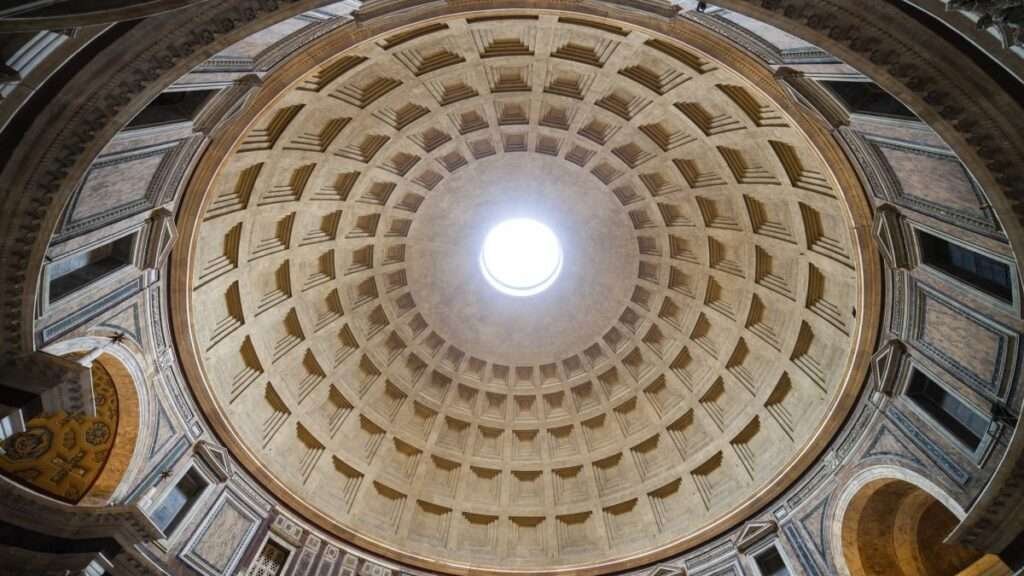
One of the most remarkable examples of Roman engineering is the Pantheon, whose oculus remains fully functional and unbroken after nearly two millennia.
This structural consistency cannot be solely attributed to the ingenuity of Roman architects or the materials they used, but also to the durability of a particular type of concrete known as Opus caementicium.
A Recipe for Long Lasting Concrete
- Pozzolana, a type of volcanic ash, played a crucial role in Roman concrete, as it reacts with lime and water to produce a compound called calcium-aluminum-silicate-hydrate (C-A-S-H).
- The C-A-S-H produced by this chemical reaction provided a stable base for the concrete, allowing it to bind the aggregate particles, such as pumice and brick fragments.
- Roman engineers took this further by incorporating aggregate particles, including crushed brick fragments and pumice.
While the inclusion of such materials has provided strength, the real secret to their durability lies beneath the surface.
The reaction between pozzolana and lime, resulting in the binding of particles and aggregates, creates a durable and long-lasting material.
This reaction is a result of the complex interactions between these materials over thousands of years, demonstrating the resilience of Roman concrete under various conditions.
Not only has Roman concrete demonstrated remarkable strength against natural phenomena, such as earthquakes, fires, and floods, but also its chemical composition has allowed it to bond with other materials and withstand external forces.















