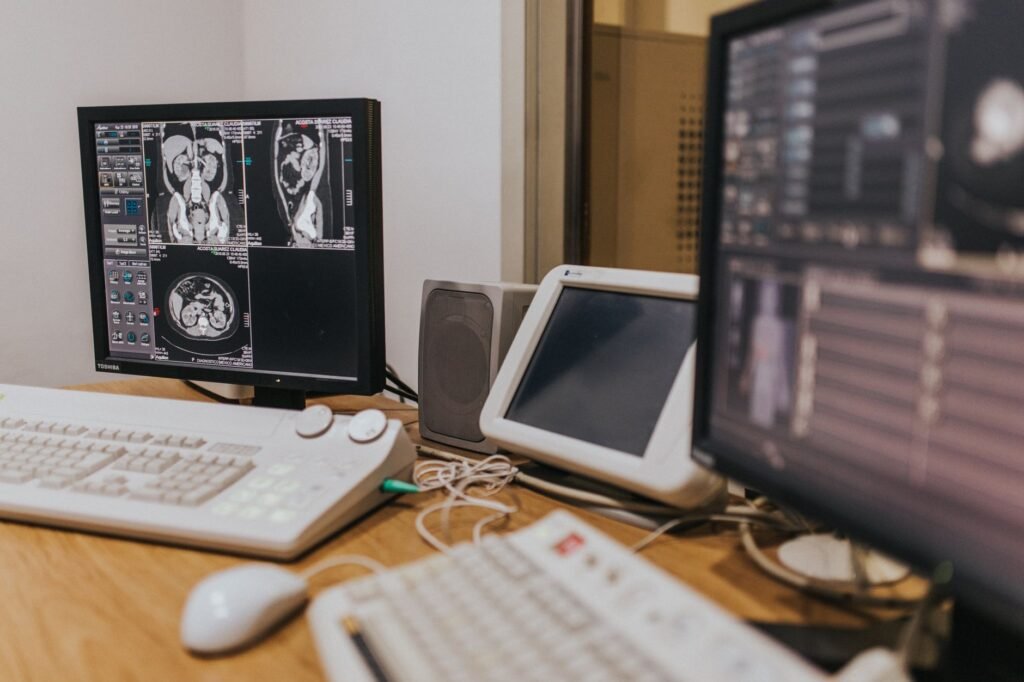
The biggest shift in healthcare over the past decade hasn’t been about a breakthrough drug or revolutionary surgery—it’s about how AI Healthcare Diagnostics is transforming patient care behind the scenes. Last year, my cardiologist used an AI-powered tool to analyze my heart scan in minutes, flagging abnormalities I hadn’t noticed during routine checkups. This isn’t science fiction; AI Healthcare Diagnostics is already making real-time decisions that improve outcomes and streamline operations across hospitals worldwide. The catch? The technology still has its growing pains—and uneven adoption means we’re not there yet where AI becomes uniformly reliable.
While AI Healthcare Diagnostics shows enormous potential, it’s not without its challenges. Some applications save lives while others create new problems like privacy concerns or diagnostic errors that can erode patient trust. The reality is becoming clearer: AI Healthcare Diagnostics isn’t about replacing doctors—it’s about giving them supercharged insights they couldn’t process before. But with so many tools emerging, how do we know which are truly effective? Where are we still stumbling as an industry?
The Speed of Diagnosis: How AI is Outperforming Human Readers in Many Cases
Think back to when radiologists spent hours hunched over X-ray films. Today, AI Healthcare Diagnostics can process the same medical images in minutes with accuracy that often surpasses human capability. At Massachusetts General Hospital, Google’s DeepMind AI detected 10% more lung cancers in CT scans than human radiologists could spot—finding subtle patterns in pixel data that experienced eyes might miss. This kind of precision could revolutionize early disease detection, but there are important trade-offs we need to examine.
Early applications of AI Healthcare Diagnostics focused on clear-cut tasks like tumor identification or fracture analysis. While these make for impressive starting points, the technology still struggles with complex cases. A stroke clinic I know implemented AI triage tools that reduced imaging analysis times by 20%. However, early reports revealed a critical flaw: the system flagged nearly one in five healthy patients as high-risk due to false positives. These aren’t just efficiency issues—they represent real opportunities lost when patients and doctors can’t trust the technology.
Where AI Healthcare Diagnostics Shines—and Where It Still Needs Work
The most reliable current applications of AI Healthcare Diagnostics excel with high-volume, structured data like radiology and pathology. Let’s look at how they’re performing:
- Radiology: IBM Watson for Radiology processes mammograms and MRIs with speeds critical during staffing shortages, helping hospitals move faster while maintaining accuracy.
- Pathology: Startups like PathAI have reduced human error in cancer cell counting by up to 9%, creating more consistent diagnoses that could save lives through earlier treatment decisions.
- Retinal imaging: Google’s DeepMind model identified diabetic retinopathy three years sooner than human doctors, potentially saving patients from irreversible vision loss. This demonstrates how AI Healthcare Diagnostics can address conditions we previously couldn’t monitor as closely.
The major limitation remains clear: garbage in equals garbage out. When hospitals in India used chatbots to diagnose fever cases based only on patient text messages, the models misdiagnosed pneumonia as flu 40% of the time. This underscores a fundamental truth about AI Healthcare Diagnostics: without clean, comprehensive data from diverse populations, these systems will continue to produce unreliable results.
From Generic Treatments to Personalized Care: The AI Revolution in Oncology and Beyond
The era of one-size-fits-all treatment plans is fading thanks to AI Healthcare Diagnostics. At Memorial Sloan Kettering, IBM’s Watson for Oncology now analyzes a patient’s tumor DNA alongside their genetics and lifestyle—identifying potential drug interactions in seconds. For my aunt battling cancer, this meant her oncologist adjusted her chemotherapy regimen based on AI predictions about how her body would metabolize medications. The result was fewer side effects and less time spent in hospital.
Yet adoption remains uneven. A 2024 physician survey found that nearly 7 out of 10 doctors don’t fully trust AI-generated treatment plans when they can’t understand how the model reached its conclusions. Meanwhile, growing concerns about data privacy raise important questions: Who controls sensitive genetic information? Could insurers use this data to influence care decisions or premiums? The AI Healthcare Diagnostics revolution could become a double-edged sword—benefiting some patients while creating new inequities we haven’t yet fully addressed.
The Hidden Bias Problem in AI-Powered Diagnostics
The more data these systems process, the bigger the potential for bias—not always because of malintent, but because of systemic gaps. A 2025 study published in Nature Medicine revealed that some diabetic retinopathy models missed warning signs in darker-skinned patients by up to 18%—a direct result of training datasets that didn’t represent diverse populations. This isn’t a technological limitation; it’s a human oversight that organizations like Partners Healthcare are only now beginning to rectify.
The industry is scrambling to fix these issues, but progress moves at a glacial pace for many patients. Meanwhile, the public worries about their health data being used against them—not just for better diagnoses, but potentially to influence care decisions based on biases we can’t even see in the algorithms themselves.
Predicting Problems Before They Become Crises: The Future of Preventive Healthcare
Some of the most impactful applications of AI Healthcare Diagnostics aren’t about curing diseases—they’re about preventing them altogether. In 2023, the UK’s NHS partnered with DeepMind to predict hospital readmissions by analyzing discharge records and appointment patterns. The system flagged at-risk patients before they even left the facility, allowing social workers to intervene early with support services.
But predictive AI Healthcare Diagnostics isn’t limited to hospitals. In rural Georgia, citrus farmers now use IBM’s Maximo AI system that analyzes drone imagery and weather data to predict crop diseases before outbreaks spread across orchards. The result? Millions saved annually by stopping disease transmission before it begins. This proves that AI Healthcare Diagnostics isn’t just for clinics—it belongs in every environment where care happens.
When Predictive AI Works—and When It Needs More Work
The most effective predictive tools today focus on high-impact scenarios with measurable outcomes:
- Chronic disease management: Kaiser Permanente’s AI flags diabetes patients at high risk for heart attacks within a year, enabling proactive lifestyle coaching that can reduce cardiovascular events.
- Supply chain optimization: St. Jude Children’s Research Hospital has reduced blood waste by 30% using predictive models to forecast demand with surgical precision.
- Infection control: Johns Hopkins Hospital uses AI to predict which hospital floors need extra cleaning staff during flu season, preventing outbreaks before they spread.
The challenge? False alarms cost money when resources are wasted. When hospitals overstock ventilators based on flawed predictions, they’re not just making poor financial decisions—they’re potentially denying other patients access to critical equipment. That’s why many institutions wait until predictive AI Healthcare Diagnostics tools reach 95% accuracy before fully implementing them—and even then, they maintain human oversight.
The Big Questions: Is AI in Diagnostics Hope or Just Hype?
AI Healthcare Diagnostics isn’t just the future—it’s here changing everything from initial diagnoses to long-term prevention strategies. But as we’ve seen throughout this discussion, the technology isn’t perfect. The real question moving forward is about balance: how can we push for innovation while maintaining ethical standards that protect patient privacy and reduce bias?
The transformative potential of AI Healthcare Diagnostics is undeniable—we’re already seeing it improve outcomes across specialties from radiology to oncology. But the question remains: How quickly can we implement these tools responsibly, ensuring benefits reach all patients—not just those in well-equipped urban hospitals? The revolution has begun. What happens next will determine whether AI Healthcare Diagnostics becomes a true force for good or remains an uneven playing field in healthcare.