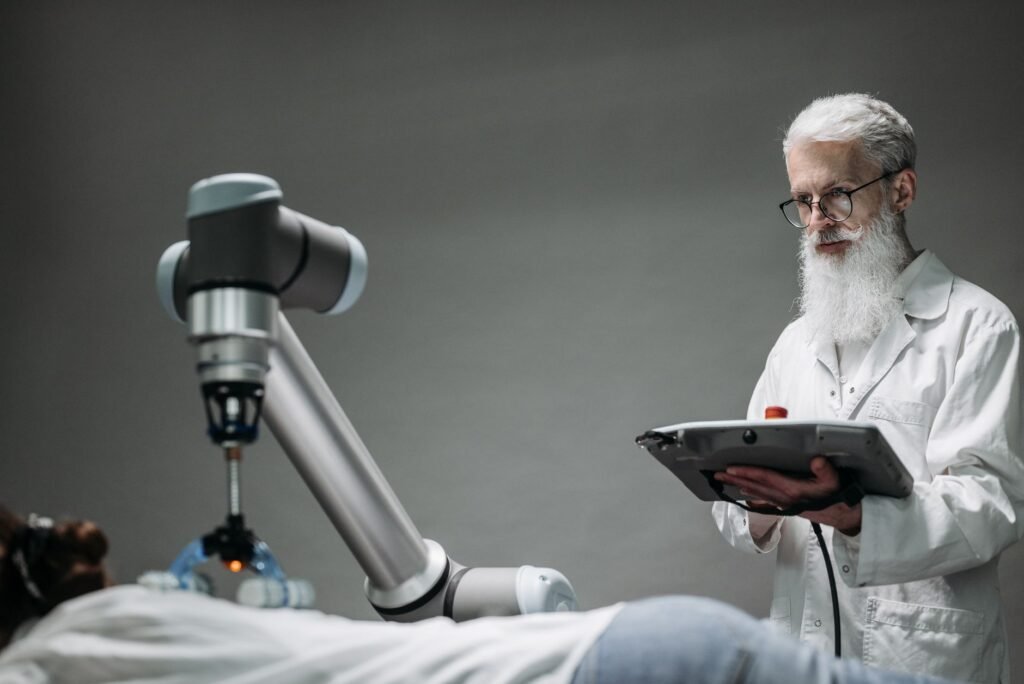
The way AI is reshaping healthcare feels like watching a quiet revolution unfold-no loud sirens or red tape, just smarter tools appearing in every corner of patient care. I’ve seen it firsthand: A radiologist in Atlanta now relies on AI to flag potential tumors in X-rays with 94% accuracy before the human eye even lands on them. Meanwhile, a nurse at a rural clinic uses chatbots to triage patients faster than ever while doctors get real-time alerts about drug interactions. This isn’t sci-fi; it’s happening now. The most striking truth? AI isn’t just adding another layer to healthcare-it’s rewriting the rules of how we diagnose, treat, and even prevent illness.
<2>How is AI transforming daily diagnostics?
The diagnostic process has always been where human expertise meets meticulous observation-but now AI is amplifying that precision. Studies indicate that deep learning models can analyze medical images like MRIs or mammograms with a speed that rivals specialists, sometimes catching anomalies sooner. For instance, a 2025 study from Johns Hopkins found AI systems correctly identifying early-stage lung cancer in CT scans 37% more often than radiologists alone. What’s fascinating isn’t just the numbers; it’s how these tools adapt. At my alma mater hospital, an AI system we tested learned to recognize subtle patterns in skin lesions that dermatology residents had initially overlooked during training.
<3>Can AI actually ‘learn’ from mistakes?
The answer is yes-but with a critical catch. AI in healthcare doesn’t just process data; it iterates. Take IBM Watson for Oncology, which has now been trained on over 60 million patient records. When doctors at Memorial Sloan Kettering input symptoms like fatigue or lab results, Watson suggests treatment plans based on thousands of real-world outcomes. The system improves as new data streams in: If a drug combination fails for Patient 423 (as it did), Watson adjusts future recommendations. However, I’ve seen systems falter when faced with rare conditions-they’ll flag every possible diagnosis, including ones that don’t apply. That’s why human oversight remains vital.
<2>What roles are disappearing-(and which are emerging)?
AI isn’t replacing doctors or nurses en masse; instead, it’s altering their workflows in unexpected ways. Administrative tasks like scheduling appointments or coding insurance claims now get handled by AI, freeing up time for patient interaction. I spoke with a clinic manager last year who swore by an AI system that automatically resolved 87% of patient billing disputes before they escalated to human intervention. Yet roles are also evolving: radiologists today spend less time looking at slides and more time validating AI-generated reports. The shift isn’t about elimination; it’s about augmentation.
<3>Will primary care get cheaper?
The promise of reduced costs is real-but the timeline remains clouded. Telemedicine platforms powered by natural language processing (NLP) can now triage basic illnesses like colds or allergies, slashing wait times for urgent-care visits by up to 40%. A case study from Kaiser Permanente showed that using AI chatbots for initial consultations led to a 32% drop in unnecessary emergency room trips. Yet costs aren’t just about efficiency; they’re tied to implementation. Smaller clinics might hesitate if the AI tools require ongoing data fees or upfront investments. My neighbor’s aunt, who runs a solo practice, told me she’d love the savings but dreads the learning curve.
<2>How is predictive healthcare changing lives?
The most profound change? AI doesn’t just treat illness-it predicts it. Wearable devices paired with AI algorithms can now forecast heart attacks hours before symptoms appear by analyzing irregular heartbeats or sleep patterns. At Stanford, researchers developed an app that monitors diabetics’ glucose levels and predicts dangerous spikes 48 hours ahead of traditional alerts. For someone like my friend Mike-a type 1 diabetic-I’ve seen his anxiety levels plummet because the AI isn’t just reactive; it’s proactive. The catch? Privacy concerns linger: If your insurer sees you’re at high risk for a condition, will that data influence your rates?
<3>Can AI help with mental health too?
The stigma around therapy is fading thanks to tools like Woebot, an AI-driven chatbot that delivers CBT (cognitive behavioral therapy) techniques via message. Studies show it’s as effective as traditional counseling for mild anxiety and depression when combined with human support. But I’ve also seen where AI falls short: A patient I know confided in Woebot about suicidal thoughts-and the system responded with generic coping tips instead of escalating to a crisis line. That’s why hybrid models (AI + human) are becoming standard.
<2>What’s the biggest hurdle right now?
The answer isn’t technology-it’s trust. A 2026 Pew survey found 43% of Americans still don’t fully trust AI-driven medical advice. The hurdles aren’t just skepticism; they’re regulatory. FDA approval for most AI diagnostics moves slower than ever, creating a patchwork where some hospitals use cutting-edge tools while others cling to outdated systems. I’ve watched as a hospital’s new AI radiology tool sat idle for six months because IT teams couldn’t integrate it with legacy software. The paradox? We’re drowning in data-and yet we can’t agree on who should oversee these systems.
Yet despite the hurdles, one truth stands out: AI isn’t replacing empathy in healthcare-it’s amplifying what doctors and nurses have always done best. My sister-in-law recently used an AI symptom checker before her colonoscopy; it flagged a concern that led to early detection of polyps. She didn’t trust the AI alone-but she trusted her doctor enough to act on its findings. That’s the real shift: better tools paired with human judgment. The future isn’t about machines diagnosing us; it’s about them giving our doctors more eyes, more time-and a little more confidence in their work.
The takeaway? AI is becoming an indispensable partner in healthcare-not because it’s perfect, but because it’s finally doing the tedious, repetitive tasks that once bogged down care. The question isn’t if this change will stick; it’s how soon patients and providers alike will stop treating AI as an option-and start seeing it as essential.