

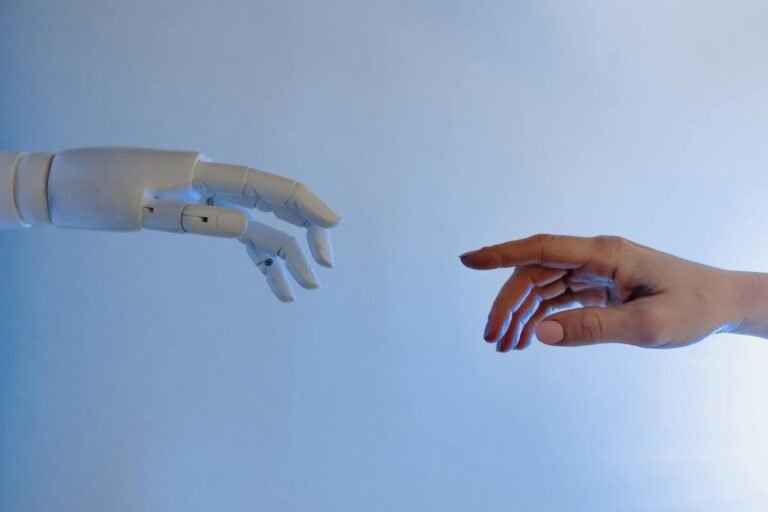
human AI collaboration is transforming the industry. Last week, I watched a financial analyst at a mid-sized investment firm freeze mid-sentence, her brow furrowed over a spreadsheet that contradicted her three-month projections. The numbers *shouldn’t* have shifted that drastically-but her model had. That’s when she pivoted to the quiet corner of her dashboard where an AI-driven analytics tool lived, not as a robot, but as a colleague. She didn’t just feed it data; she *debated* with it, challenging its 90% confidence interval for a commodity price spike. The tool flagged a potential error in her macroeconomic assumptions, and together-human intuition plus machine precision-they landed on a revised forecast that saved the firm 8% on a pending trade. That’s human-AI collaboration in action: not a handoff, but a partnership where neither partner dominates.
human AI collaboration: Where Collaboration Excels
Human-AI collaboration isn’t sci-fi. It’s already rewiring industries from healthcare to creative storytelling, but most teams still treat AI like a glorified calculator rather than a conversational partner. Industry leaders know the truth: the magic occurs when you divide cognitive labor like a jazz ensemble. Humans excel at contextual nuance-like spotting ethical blind spots in a dataset or reading the unspoken tension in a client’s voice during a call. AI, meanwhile, thrives in the repetitive, high-volume work: cross-referencing 50,000 financial filings in minutes or identifying patterns in patient imaging that would take a radiologist weeks.
Take Bloomberg Terminal’s AI-assisted research platform. Traders don’t ask the AI to *make* decisions; they ask it to flag anomalies in real-time currency flows that their experience might have missed. The system crunches terabytes of data in seconds, but it’s the human who decides whether a sudden spike in a single commodity trade is noise or a harbinger of broader market shifts. That’s human-AI collaboration: the AI handles the volume, the human handles the judgment.
Three Rules to Balance the Partnership
Yet I’ve seen even sophisticated teams stumble into the same trap: assuming AI will handle the strategic while humans manage the tactical. That’s backwards. Humans should lead the strategy, while AI executes at scale. Consider the product team I worked with at a fintech startup: they used AI to generate thousands of prototype names based on market trends-then passed the most promising options to human designers for refinement. The AI handled the brute-force creativity; the humans ensured the output aligned with brand identity and emotional resonance.
So how do you replicate this balance? Start with these three non-negotiables:
- Human-first objectives: Before feeding data to an AI, ask: *What’s the ultimate human goal here?* Is it risk mitigation? Creative problem-solving? Tailor the AI’s output to serve that objective-never the other way around.
- Iterative feedback loops: Treat the AI like a junior colleague. If its draft lacks emotional nuance in a client report, don’t accept it. Push back: *“This tone feels robotic. Can we make it sound like a person wrote it?”* Over time, the model will adapt.
- Human oversight for fairness: I’ve watched teams deploy AI for resume screening only to realize the system favored candidates with specific keywords-regardless of cultural fit. Human oversight is non-negotiable for ethical compliance, creativity, and nuanced decisions.
Practical Steps to Launch Collaboration
Scaling human-AI collaboration doesn’t require a corporate overhaul. Start small with these actionable tweaks:
First, designate an “AI liaison” per team-a person responsible for training others to ask the right questions of the system. Their role? Bridge the gap between human intuition and AI output. Second, institutionalize “red team” sessions before finalizing AI-generated recommendations. Ask: *“What’s one way this could be wrong?”* Even if the AI’s answer holds up, the debate sharpens the human’s reasoning. Finally, track how often your team *questions* AI suggestions versus blindly adopting them. A lopsided ratio signals an imbalance in the partnership.
Think about the medical team using AI to flag potential diagnoses in mammograms. The system spots suspicious clusters faster than a radiologist, but it’s the human who evaluates the patient’s family history, psychological cues, or even hesitation in describing symptoms. The AI doesn’t “diagnose”; it informs. The doctor doesn’t just “listen”; she interprets. Neither could excel alone. The AI handles the data; the human handles the human.
The hype around AI replacing jobs is overblown. The future belongs to teams where humans and machines work as equals-not competitors. The analyst who started this story didn’t outsource her work to an AI. She partnered with it, leveraging her expertise to guide the machine’s precision and the machine’s speed to amplify her judgment. That’s the reality of human-AI collaboration today. And it’s only getting better.










