

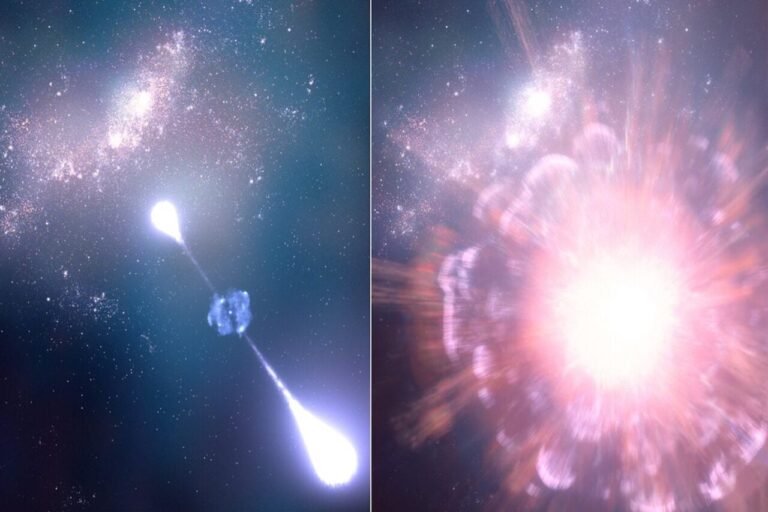
Webb Traces Distant Explosion. The universe is a vast and mysterious expanse, full of hidden secrets waiting to be uncovered.
red. One of the most intriguing phenomena that scientists have been studying for years is the birth and death of stars.
The most recent breakthrough in this field comes from the James Webb Space Telescope, which has detected the remnants of a distant supernova explosion.
This ancient stellar death took place when the universe was a mere 730 million years old.
In order to understand the significance of this discovery, it’s essential to have a basic understanding of the structure and evolution of the universe.
The Big Bang theory, which is widely accepted by the scientific community, states that the universe began as a singularity, an infinitely hot and dense point, around 13.8 billion years ago. This singularity expanded rapidly, and as it did, it cooled, allowing the formation of subatomic particles, atoms, and eventually, the first stars.
These stars played a crucial role in the formation of galaxies, including our own Milky Way.
Supernovae, on the other hand, are the explosive deaths of stars that occur when they run out of fuel. This process releases an enormous amount of energy, making supernovae visible from millions of light-years away.
By studying these events, scientists can gain valuable insights into the history of the universe, including the composition of the cosmos and the rate at which it has expanded.
The detection of the oldest supernova ever observed by the James Webb Space Telescope is a remarkable achievement.
The telescope’s advanced instruments allowed it to capture a faint signal from an explosion that occurred over 13.8 billion years ago. This signal was then compared with simulations of supernova explosions, confirming that it was, in fact, a genuine event.
As a result, scientists now have a new piece of information about the history of the universe, allowing them to refine their existing theories.
This discovery also highlights the potential of the James Webb Space Telescope, which promises to revolutionize our understanding of the universe.
The telescope’s advanced sensors and precise optics enable it to detect faint signals from the farthest reaches of the cosmos.
As more research is conducted using this telescope, scientists can expect to uncover new secrets about the universe and its history.
One potential area of research that scientists are exploring is the possibility of using supernova observations to better understand the structure of the universe.
While scientists have a good understanding of the large-scale structure of the universe, there is still much to be learned about the smaller scales.
By studying supernovae across the universe, scientists hope to gain a deeper understanding of the cosmos and the way that it evolved over time.
- Solar system formation theories
- Stellar evolutionary processes
- Galaxy formation and evolution
Supernova research is an ongoing area of study that continues to captivate scientists.
From its early days, the James Webb Space Telescope has shown incredible promise in advancing our understanding of the universe.
Source
Despite its achievements, the James Webb Space Telescope still has much to offer.
By continuing to gather data and conduct research, scientists can refine their existing theories and uncover new secrets about the universe.
Ultimately, understanding the universe and its mysteries is an ongoing process that will take time, effort, and dedication.
The discovery of the oldest supernova ever observed is a testament to the power of scientific inquiry and our quest to understand the universe.
By pushing the boundaries of what is thought to be possible, we continue to drive innovation and expand our knowledge of the cosmos.
The universe is a complex and ever-changing tapestry, full of hidden patterns and mysteries waiting to be unraveled.
With continued research and the support of scientists and engineers, we can continue to explore the universe and uncover new secrets about its workings.










