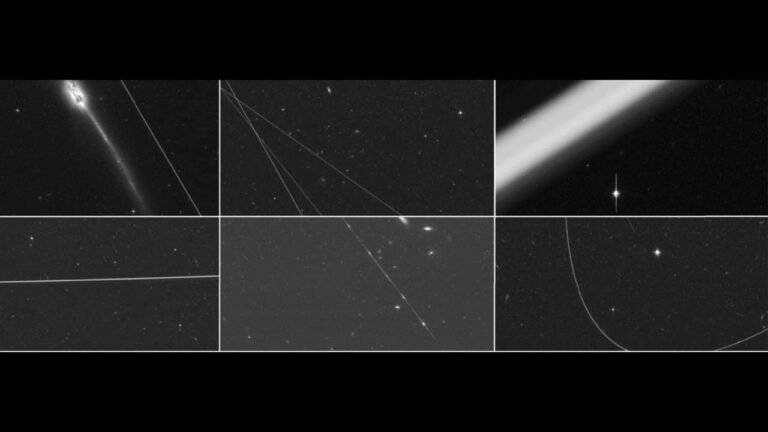
Satellite constellations could obscure most space telescope observations by late 2030s, according to recent reports, leaving astronomers and scientists worried about the long-term effects on space exploration.
As the number of satellite constellations grows, so does the concern about their impact on space telescopes, with more space telescopes potentially being affected when these constellations are launched in the coming years.
The rise of satellite constellations has opened up new opportunities for communication and navigation, but their increasing density threatens the quality of astronomical observations.
The main issue lies in the fact that many of these satellites will be placed in low Earth orbit, and as the number of satellites increases, the light from the stars behind them may be obstructed by the reflected light from these satellites, affecting the image quality and resolution of space telescopes.
This can result in the loss of crucial data and potentially obscure the entire image, leaving a portion of the sky forever lost.
Astronomers and scientists are now trying to anticipate the full extent of the problem to determine what can be done to mitigate it.
Researchers have been studying the issue, taking into account factors such as the density of the satellite constellations, the number and location of space telescopes, and the timing of their observations.
The question now is, how many more space telescopes will be affected when all these constellations are launched, and what measures can be taken to minimize the impact on space exploration?
The long-term effects of this problem are likely to be significant, and it remains to be seen how satellite operators and space agencies will address this issue, and what measures they will take to protect astronomical observations.
Astronomers Concerned
Satellite constellations are expected to be deployed in large numbers in the coming years, with many companies already having plans in place for massive satellite launches.
This growth in satellite constellations raises concerns about the impact on space telescopes and the long-term preservation of astronomical observations.
Astronomers are worried that the reflected light from these satellites could block the light from distant stars, compromising the quality and resolution of images captured by space telescopes.
Space Telescope Concerns
Many space telescopes have been observing the universe for decades, providing unprecedented insights into the cosmos.
However, as satellite constellations continue to grow, the quality of these observations may be compromised, potentially leading to a loss of data and understanding.
Some of the telescopes that may be affected include those in low Earth orbit, such as the Hubble Space Telescope, which has been observing the universe for over three decades.
Measures to Be Taken
Astronomers and scientists are now exploring ways to mitigate the impact of satellite constellations on space telescopes.
Some potential solutions include adjusting the trajectory of space telescopes to avoid areas of high satellite density, or designing new telescopes that can observe in wavelengths unaffected by satellite reflections.
Researchers are also considering implementing regulations to limit the number of satellites and reduce the impact on astronomical observations.
In conclusion, the growth of satellite constellations poses a significant challenge to space telescopes and the preservation of astronomical observations.
The impact of this problem will likely be significant, and it remains to be seen how the industry will address it.
TAGS: astronomy, satellite constellations, space exploration
SEO_DATA:
SEO_TITLE: Satellite Constellations Threaten Space Telescope Observations
SEO_DESC: The growth of satellite constellations is expected to have a significant impact on space telescopes and the preservation of astronomical observations.
FOCUS_KW: satellite constellations