End Work As We. Watching the arguments about job loss and AI feels like rewatching an old movie to me. I was a very, very early adopter of desktop computing (1979) and email (1980).
0). It made all of the difference in my life and career. I often tell people that I was freed when I got my first keyboard.
I read widely and studied the forecasts trying to understand how to take advantage of the emerging opportunities. I went to a vocational school to learn to code (1979). I researched every new piece of software and learned how to make machines overcome their limitations.
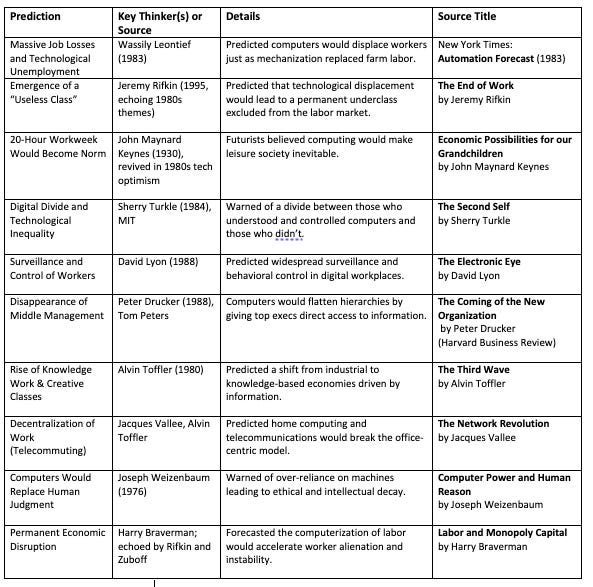
In the 1980s, computing and automation technologies began reshaping industries. Many thinkers made bold predictions about how these tools would transform work. Some predictions proved prophetic. Others captured the fears and hopes of a society standing at the edge of the digital revolution.
Predictions, Their Proponents, and the Reality
This following list presents key predictions, their proponents, detailed context, and relevant source titles. A list of URLs for further reading is not included in this piece.
- Prediction 1:Machines would replace routine, repetitive and mundane work — This was predicted by Charles Babbage, the father of the computer. He saw the potential of machines to automate tasks and free humans from laborious work.
- Prediction 2:Work would become less physically demanding — This was predicted by Paul Goodman, an American author and sociologist. He believed that technology would make work less burdensome and more flexible.
- Prediction 3:There would be a universal basic income for all citizens — This was predicted by John Humphrey Noyes, an American utopian. He envisioned a society where technology provided for everyone’s basic needs.
- Prediction 4:Work would become more creative and fulfilling — This was predicted by Ernest Callenbach, an American author and activist. He believed that technology would enable people to pursue more meaningful and creative work.
Scan the list. You’ll find some familiar themes. Great shifts in technology usually provoke big feelings and big fears. The reality is almost always slower and smaller than the hype.
We’re facing another great shift now, with AI and automation on the rise. What does it mean for our work and lives? Are we doomed to lose our jobs, or will we find new opportunities? The answers, like the predictions of the past, are still unclear.
We can’t predict the future, but we can learn from the past. By understanding the predictions and realities of earlier technological shifts, we can better navigate this new landscape.
It’s a new world, full of challenges and opportunities. The question is, how will we shape it?
For more on how to thrive in this new work landscape, check out the future of work series.