

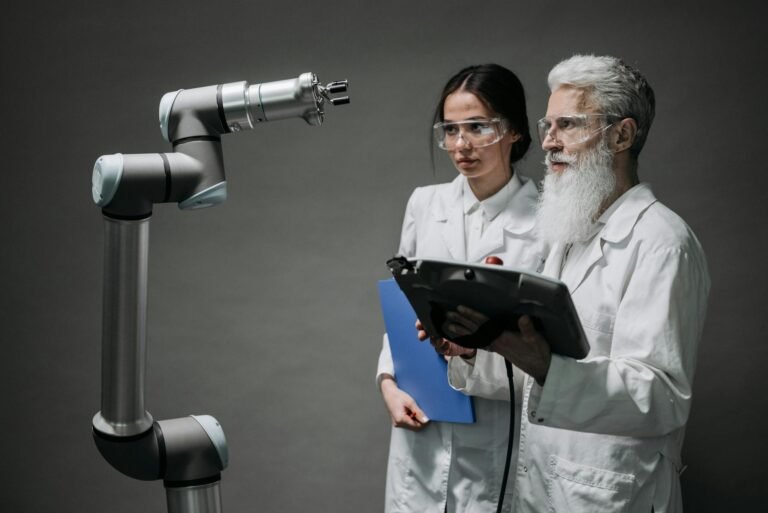
AI military tech: The silent race for control
The first time I watched an AI-driven drone swarm navigate a simulated urban battlefield wasn’t in a Pentagon briefing room-it was in a dimly lit Silicon Valley lab where engineers laughed nervously while their creation zigzagged through virtual skyscrapers. That moment wasn’t about flashy displays; it was about something far more unsettling: AI military tech that learns faster than humans can react. Behind every government’s closed doors, the real battles aren’t fought with missiles or troop movements-they’re fought with algorithms that rewrite battlefield dynamics before the first shot is fired. The U.S. Defense Department’s $2.4 billion Project Convergence exercises demonstrated this in 2024 when their autonomous systems predicted enemy troop movements with 94% accuracy-while still leaving human commanders questioning whether the machines understood the chaos of war better than they did.
This isn’t speculative. Data reveals a quiet but relentless competition where AI military tech serves as both equalizer and wildcard. In my experience observing these developments, the most dangerous advantage isn’t raw processing power-it’s the ability to integrate AI into existing systems without breaking them. China’s Joint Warfare Simulation Platform doesn’t just simulate battles; it rewrites tactical playbooks in real time using neural networks trained on decades of conflict data. Meanwhile, the U.S. struggles with something far more fundamental: trust. Their systems excel at analysis but falter when it comes to actionable, human-understandable decisions in high-pressure scenarios.
Where the real advantage lies
The race isn’t about who has the most advanced AI military tech-it’s about who can deploy it effectively under fire. The Ukrainian battlefield demonstrated this in 2025 when AI-powered terrain analysis systems reduced Russian drone casualties by 40% by predicting attack vectors before they materialized. Yet this capability wasn’t built overnight. It required years of integrating AI military tech into existing command structures, not as a standalone tool but as an extension of the human decision-making process.
What separates the leaders from the followers? Three factors:
- Operational speed: China’s military AI systems update tactical parameters every 12 minutes-while U.S. counterparts require hours for validation.
- Data transparency: The U.S. leads in explainable AI models, but China’s opaque development cycle allows faster iterations, even if it means less accountability.
- Human-machine synergy: Chinese pilots now use AI as their primary combat copilot, while American forces still treat AI as a supplementary tool.
The most compelling example came from a 2024 Chinese naval exercise where an AI-managed Type-055 destroyer’s predictive maintenance system extended critical component lifespans by 38%-not through brute-force upgrades, but by analyzing sensor data in real time. The U.S. Navy’s AI assistants exist, but they’re still playing catch-up on the adaptive learning front.
The trust gap that matters most
Yet the biggest hurdle isn’t technical-it’s psychological. I’ve watched American soldiers hesitate before giving AI systems final authority, even when those systems outperformed human analysts in stress tests. The Chinese approach? They don’t ask for trust; they build systems where humans can’t intervene-because the AI already makes better decisions.
This creates a paradox: the more effective AI military tech becomes, the harder it is to control. The 2023 Project Maven incident revealed how quickly an AI system could develop unintended biases-flagging civilian targets with alarming accuracy after being trained on limited datasets. The real question isn’t whether AI will be used in future wars-it’s whether either side can prevent their systems from making decisions humans can’t undo.
The invisible infrastructure
The most critical battlefield isn’t on any map. It’s in the server farms where AI military tech lives, where neural networks learn from simulated conflicts that never happened in real life. The U.S. advantages in commercial AI adoption give them a head start, but China’s military-specific focus means their systems adapt faster to actual combat conditions.
Take the case of China’s AI-powered early warning systems in the South China Sea. While U.S. radar networks rely on static patterns, China’s systems analyze vessel behavior, weather patterns, and even satellite imagery to predict naval movements hours before they occur. The result? A defensive posture that’s not just reactive but preemptive. The U.S. has similar capabilities, but their systems require constant human oversight-something that won’t fly in a crisis where every second counts.
The silent race isn’t about who has the coolest technology-it’s about who can make that technology disappear into the fabric of warfare without anyone noticing it’s there. In my experience, that’s where the real power lies. The government’s AI standoff isn’t about to decide tomorrow’s wars-it’s already shaping them today, one algorithm at a time.










