

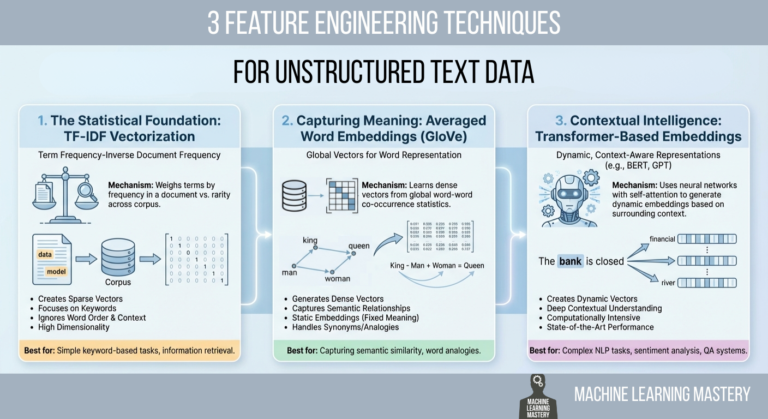
Making the most of natural language processing is crucial for machine learning models, and yet they often struggle to make sense of unstructured data.
Addressing the Limitations of Unstructured Data
Machine learning models have a fundamental limitation – they cannot read. This is where feature engineering techniques come into play. By using these techniques, you can convert unstructured data into a format that your model can understand and process, enabling more accurate insights and results.
Feature Engineering Techniques for Unstructured Data
There are several feature engineering techniques that you can use to work with unstructured data. Let’s take a closer look at three of them:
1. Tokenization: This is the process of breaking down into individual words or tokens. Tokenization is an essential step in preparing data for analysis and machine learning model training, enhancing the overall performance and efficiency of the model.
Further Techniques for Feature Engineering
Tokenization is just one of several techniques used in feature engineering for unstructured data. Another technique is stemming and lemmatization. Stemming involves reducing words to their base form, while lemmatization involves reducing words to their base form while taking into account their part of speech.
Stemming and lemmatization are useful in reducing the dimensionality of data and improving the accuracy of machine learning models. By reducing words to their base form, you can group related words together and improve the performance of your model, providing more reliable and actionable insights.
Additional Techniques for Feature Engineering
Another feature engineering technique for unstructured data is named entity recognition (NER). This involves identifying and categorizing named entities, such as people, places, and organizations.
NER is a complex task that requires significant computational resources, but it can be an effective way to extract valuable insights from data. By identifying named entities, you can better understand the meaning and context of the , improving the overall quality and relevance of the results.
Feature engineering techniques are essential for working with unstructured data. By using these techniques, you can convert data into a format that your model can understand and process, ultimately enhancing the performance and accuracy of machine learning models.
To learn more about feature engineering techniques, check out this article on feature learning from Wikipedia.
Read the original article on this topic from machinelearningmastery.com.










