

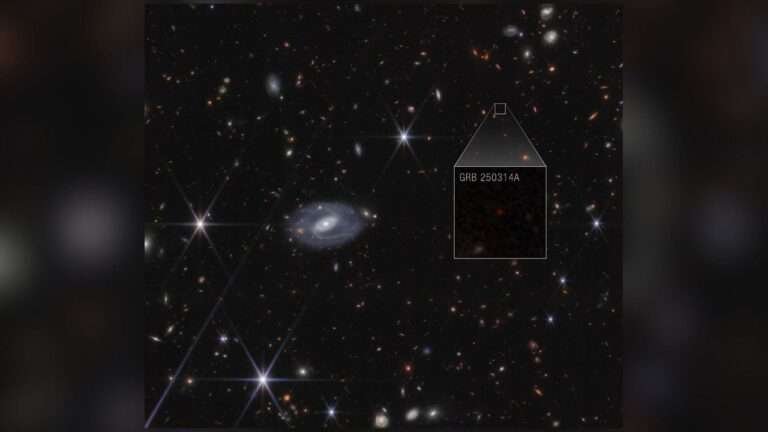
The James Webb Space Telescope has once again made headlines with its latest discovery, the oldest supernova ever seen. This groundbreaking find has opened up new avenues of research and has left scientists buzzing with excitement.
Located in a galaxy far, far away, the supernova exploded over 13 billion years ago, during a time when the universe was in its formative stages. This is a truly mind-boggling concept, made possible only by the advanced technology and capabilities of the James Webb Space Telescope.
Supernovae are incredibly powerful explosions that occur when a star reaches the end of its life cycle and collapses in on itself. They can have a profound impact on the surrounding environment, scattering elements and energy throughout the cosmos.
The discovery of this ancient supernova is significant not only because of its age but also because of the insights it offers into the early universe. By studying the light from the supernova, astronomers can gain a better understanding of the conditions that existed at that time, including the composition of the universe and the distribution of elements.
The universe has undergone immense change over the past 13 billion years, with galaxies and stars forming, colliding, and evolving in complex ways. This discovery offers a unique window into the past, allowing scientists to piece together the history of the cosmos.
The James Webb Space Telescope has been instrumental in making this discovery possible, thanks to its advanced infrared capabilities and state-of-the-art technology. This is just one of many groundbreaking finds that the telescope has made in recent months, and it is clear that it will continue to play a major role in our understanding of the universe for years to come.
The study of supernovae is a fascinating and complex field that has far-reaching implications for our understanding of the universe. By continuing to study these powerful explosions, scientists can gain a deeper understanding of the fundamental laws of physics and the evolution of the cosmos.
The discovery of the oldest supernova ever seen is a testament to the power of human curiosity and the importance of pushing the boundaries of scientific knowledge. As we continue to explore the universe and uncover its secrets, we are reminded of the awe-inspiring beauty and complexity of the cosmos.
Astronomers will continue to study the light from the supernova to gain a better understanding of the conditions that existed at that time. The implications of this discovery are far-reaching and will likely have a significant impact on our understanding of the early universe.
Linking this discovery to the ongoing evolution of galaxy formation theories, scientists can gain a deeper understanding of how galaxies and stars formed in the early universe.
This is just the beginning of an exciting new chapter in our understanding of the universe, and the James Webb Space Telescope will undoubtedly play a major role in this journey of discovery.
The universe is an infinite and mysterious place, full of secrets waiting to be uncovered. As we continue to explore and study the cosmos, we are reminded of the importance of curiosity-driven science and the awe-inspiring beauty of the universe.
The discovery of the oldest supernova ever seen is a shining example of the wonders that await us in the universe. By continuing to push the boundaries of scientific knowledge and exploring the unknown, we can gain a deeper understanding of the cosmos and our place within it.
The James Webb Space Telescope has opened up new avenues of research and has left scientists buzzing with excitement. The implications of this discovery are far-reaching and will likely have a significant impact on our understanding of the early universe.
The discovery of this ancient supernova is significant not only because of its age but also because of the insights it offers into the early universe. By studying the light from the supernova, astronomers can gain a better understanding of the conditions that existed at that time.
The study of supernovae is a fascinating and complex field that has far-reaching implications for our understanding of the universe. By continuing to study these powerful explosions, scientists can gain a deeper understanding of the fundamental laws of physics and the evolution of the cosmos.
As we celebrate this groundbreaking discovery, we are reminded of the importance of curiosity-driven science and the awe-inspiring beauty of the universe. The universe is an infinite and mysterious place, full of secrets waiting to be uncovered.
The implications of this discovery are far-reaching and will likely have a significant impact on our understanding of the early universe. By continuing to study the light from the supernova, astronomers can gain a deeper understanding of the conditions that existed at that time.
For more information on this groundbreaking discovery, visit: source










