
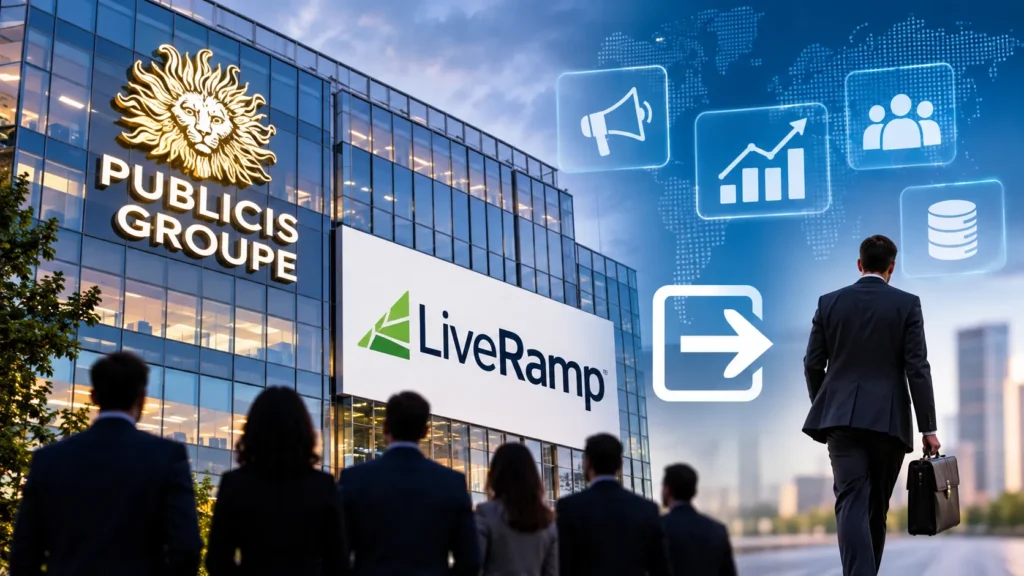
Publicis Groupe has officially completed its $2.2 billion acquisition of LiveRamp, marking a significant development in the global advertising and marketing technology industry. However, the announcement has also raised concerns among advertisers and brands that rely on LiveRamp for managing customer data and digital advertising campaigns.
The Publicis LiveRamp deal was finalised on November 2, 2026, following regulatory approval and an agreement with the US Federal Trade Commission. While Publicis sees the acquisition as an opportunity to strengthen its artificial intelligence capabilities, some brands are questioning whether the platform can maintain its independent position in the market.
The development highlights growing tensions around data ownership, competition and trust in an advertising industry increasingly driven by artificial intelligence.
Why Some Brands Want to Leave LiveRamp
One of the most notable reactions came from Liquid Death, whose chief media and digital commerce officer, Benoit Vatere, publicly expressed concerns about Publicis owning the platform.
Following the acquisition announcement, Vatere indicated on LinkedIn that the brand planned to move away from LiveRamp. A Liquid Death representative subsequently confirmed the company’s intention to leave the platform.
His concerns focused on the risks of allowing a major advertising holding company to own technology that manages valuable customer data and audience identity information.
The reaction has attracted attention from other marketing professionals, with several industry participants discussing alternative data collaboration platforms.
The Publicis LiveRamp deal has therefore become more than a major corporate acquisition. It has developed into a wider discussion about whether advertisers can confidently share information through technology owned by one of their potential competitors.
WPP and Omnicom Also Reconsider Their LiveRamp Relationships
The concerns are not limited to individual brands. Major advertising groups, including WPP and Omnicom, have also signalled plans to reduce or move away from their use of LiveRamp.
Both companies compete directly with Publicis in the global advertising market. Their concerns reflect the possibility that a competitor could own an important part of the technology infrastructure used by multiple agencies.
WPP has highlighted its InfoSum data collaboration platform as an alternative. Meanwhile, Omnicom has been developing its own identity solution, Real ID, through its Acxiom business.
These developments could create new opportunities for competing marketing technology providers.
However, moving away from an established data platform is not necessarily straightforward. Advertisers may need to rebuild integrations, review existing contracts and ensure that audience measurement and campaign activation continue without disruption.
Publicis Promises Data Protection and Platform Independence
Publicis has defended the acquisition by emphasising that LiveRamp will continue operating as an independent business.
The company has also committed to maintaining fair access for clients, agencies and technology partners, regardless of their relationship with Publicis.
An agreement with the Federal Trade Commission introduced additional safeguards, including restrictions on access to competitors’ confidential information, independent oversight and requirements to preserve fair access to LiveRamp services.
These commitments are intended to address concerns that Publicis could use its ownership to gain an unfair competitive advantage.
Publicis CEO Arthur Sadoun has presented the acquisition as a major step towards building an integrated artificial intelligence growth platform. The company plans to combine LiveRamp’s data collaboration technology with Epsilon’s identity capabilities.
This approach is designed to help businesses connect customer information, personalise advertising, measure campaign performance and develop AI-powered business applications.
How the Acquisition Could Change Digital Advertising
The Publicis LiveRamp deal arrives at a time when advertisers are reconsidering how they collect, manage and activate customer information.
First-party data has become increasingly important as businesses seek more direct relationships with customers and greater control over marketing information.
LiveRamp provides technology that helps organisations connect customer data across different platforms while supporting advertising measurement and audience targeting.
By combining these capabilities with Epsilon, Publicis aims to offer businesses a more integrated marketing technology environment.
However, the acquisition could also encourage competitors to invest more heavily in independent data infrastructure.
For advertisers, this may create more choices but could also increase the complexity of managing multiple technology providers.
Privacy expectations and changing digital advertising practices are adding further pressure. Businesses must consider not only campaign performance but also how customer information is collected, shared and protected.
What Advertisers Should Consider Before Choosing a Data Platform
The latest developments offer an important lesson for businesses investing in marketing technology.
Advertisers should evaluate technology providers based on data ownership, transparency, security practices and long-term flexibility rather than relying entirely on established industry relationships.
They should also understand how their information is stored, who can access it and whether they can transfer their data if they decide to change providers.
The Publicis LiveRamp deal demonstrates why technology independence and customer trust are becoming important competitive factors in digital advertising.
As artificial intelligence continues to reshape marketing operations, businesses will need solutions that balance automation, personalisation, privacy and control.
For the advertising industry, the biggest question is no longer simply which platform offers the most advanced technology. It is whether businesses can trust that platform with their most valuable customer information.
Stay Ahead of Marketing Technology Developments
The changing relationship between Publicis and LiveRamp offers valuable insights into the future of digital advertising, data privacy and marketing technology. Businesses should closely monitor these developments before making long-term technology decisions.
Connect with TheBusinessSeries for expert perspectives, industry developments and the latest Technology insights and Marketing trends analysis.
Reach out to our team to explore emerging business opportunities and stay informed about changes shaping the global technology and advertising landscape.